|
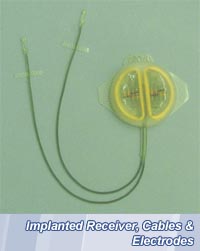 The Finetech Dropped Foot System is
a new device currently undergoing clinical trials for
the treatment of dropped foot, a chronic condition
suffered by stroke patients and others and characterised
by the inability to raise the foot during the swing
phase of walking. People who suffer from this problem
tend to have a laboured and unsafe gait, needing to
hitch and circumduct their hip in order to swing their
hemiplegic leg clear of the ground. The increased energy
expenditure needed leads to fatigue, further reduction
in the speed and distance walked, and often a further
increase in spasticity. The Finetech Dropped Foot System is
a new device currently undergoing clinical trials for
the treatment of dropped foot, a chronic condition
suffered by stroke patients and others and characterised
by the inability to raise the foot during the swing
phase of walking. People who suffer from this problem
tend to have a laboured and unsafe gait, needing to
hitch and circumduct their hip in order to swing their
hemiplegic leg clear of the ground. The increased energy
expenditure needed leads to fatigue, further reduction
in the speed and distance walked, and often a further
increase in spasticity.
The
current approaches for dropped foot correction are
fixation of the ankle joint by a brace, or electrical
stimulation applied to a nerve in the leg through
electrodes attached on the skin surface (surface
stimulation). However, there can be significant
drawbacks associated with surface stimulation. For
example, in order to achieve the correct movement of the
foot, the surface stimulation approach requires accurate
placement of the electrodes, which is both difficult and
rather time consuming. Also, with the surface approach,
discomfort or pain can occur, either as a result of a
skin reaction to the electrodes, or as a result of
electrical current passing through the skin.The Finetech
System, in contrast to the surface stimulators, has an
implanted part that is directly attached to appropriate
nerves and therefore the problems of electrode placement
have been eliminated. Also, stimulation will be less
painful, as the stimulation current does not pass across
the skin.
The
other novel aspect is that the system has two
stimulation channels, this allows for a certain degree
of adjustment of the resulting foot movement.
The
stimulator can be thought of in two parts; the implant,
which the surgeon will place under the skin of the leg
and the external equipment (transmitter, belt, charger
and switch). More extensive details on the implant are
available on request.
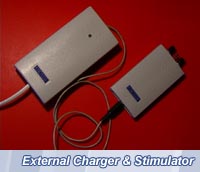 The basic operation of the system
is as follows. The basic operation of the system
is as follows.
The foot switch located under the heel detects
when the heel leaves the floor during walking. When this
happens, a signal is sent along the wire connecting the
heel switch to the transmitter and the transmitter
becomes active, transmitting power and signals to the
implanted receiver. The level of stimulation on each
channel is set by adjustment of the transmitter. The
signals are transformed by the receiver and result in
electrical pulses being delivered to nerves supplying
muscles around the ankle. Soon after the heel touches
the ground again, the stimulation is switched off, in
readiness for the next time that the heel leaves the
ground. In some cases, it is possible that the heel will
not touch the ground at the next step and in these
cases, stimulation will automatically be turned off
after four seconds.
 |
For
instructions on how to print this page click the
button
| |